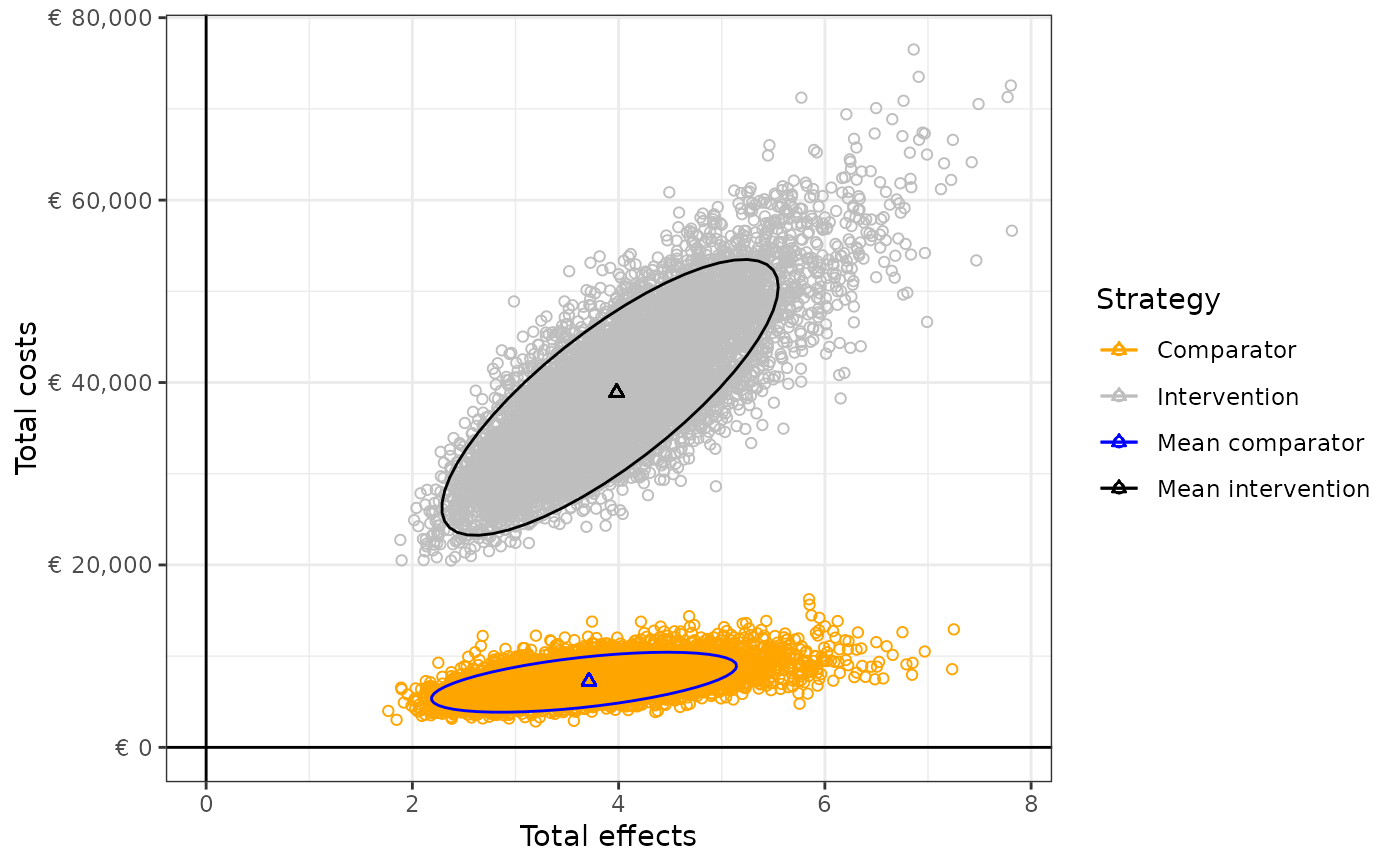
This function plots the cost-effectiveness plane for two strategies.
Arguments
- df
a dataframe.
- e_int
character. Name of variable of the dataframe containing total effects of the intervention strategy.
- e_comp
character. Name of variable of the dataframe containing total effects of the comparator strategy.
- c_int
character. Name of variable of the dataframe containing total costs of the intervention strategy.
- c_comp
character. Name of variable of the dataframe containing total costs of the comparator strategy.
- currency
character. Default is "euro". Determines the currency sign to use in the incremental cost effectiveness plane. Currently included signs: "euro", "dollar", "yen", "none".
- axes
logical. Default is TRUE, axes are plotted at x = 0 and y = 0. If FALSE, no axes are plotted.
Examples
# Plot cost effectiveness plane
data("df_pa")
plot_ce(df = df_pa,
        e_int = "t_qaly_d_int",
        e_comp = "t_qaly_d_comp",
        c_int = "t_costs_d_int",
        c_comp = "t_costs_d_comp",
        currency = "none"
        )